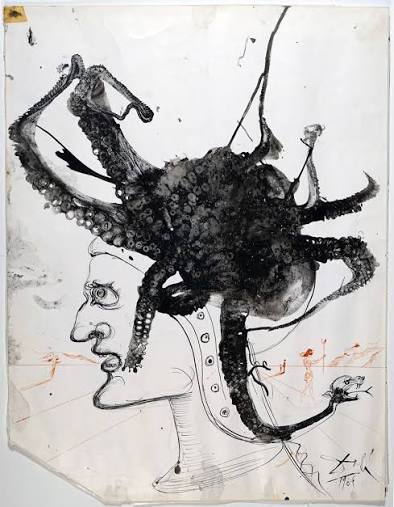
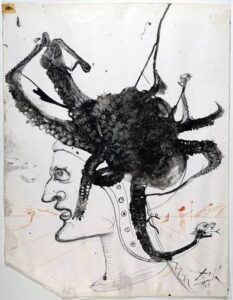
This piece, executed in Chinese ink and sepia ink on paper, represents one of Dalí’s many explorations of literary and philosophical figures. In this case, the sitter is Dante Alighieri, the celebrated Italian poet and author of
The Divine Comedy.
Dalí employs a fine and meticulous line to delineate Dante’s face, evoking classical Renaissance busts with their clearly defined profile. However, the presence of an octopus resting upon his head introduces a disturbing and surreal element. The cephalopod’s tentacles extend in different directions, becoming entangled with the figure and suggesting a symbolic fusion between the poet and the marine creature.
The work appears to suggest a vision of Dante’s mind as a space in which external, chaotic, and overwhelming forces take hold of his thoughts. This may be related to the poet’s journey through Hell, Purgatory, and Paradise, where tormented souls and infernal punishments evoke twisted and disturbing imagery, akin to the organic and uncontrollable form of the octopus.
Salvador Dalí, always fascinated by experimentation and by the connection between art and nature, employed an unconventional method in some of his works: using ink from live octopuses. According to documented accounts, Dalí obtained these cephalopods directly from fishermen in Riba de Portlligat, the small coastal village where he maintained his home and studio.
In his constant search for new techniques and materials, Dalí used the ink of freshly caught octopuses to create organic stains on paper. In many of his works, particularly sketches and preliminary studies, he used this natural ink as a foundation, allowing its fluidity to generate random and unpredictable forms. He would then intervene upon these spontaneous marks with precise lines of Chinese ink, defining human figures, animals, or symbolic elements.
In the case of
Portrait of Dante with Octopus (1964), it is highly likely that Dalí employed this method in creating the cephalopod that dominates the composition. The dense texture and mottled appearance of the octopus suggest the use of freely applied ink, allowing the substance to spread across the paper before the more defined details were added.
Symbolism and Context
Dalí always demonstrated a profound admiration for classical literature and, in particular, for
The Divine Comedy, which he illustrated on several occasions.
In this portrait, the artist appears to suggest that Dante’s mind is trapped within a tangle of dark thoughts, as though dominated by uncontrollable forces of the subconscious. The use of the octopus as a symbol can be interpreted in several ways:
- The irrational and the dreamlike: Dalí’s Surrealism frequently engages with the unconscious and the chaotic. The octopus, with its ability to camouflage itself and its constantly changing form, can represent an elusive and shifting stream of thought.
- Intellectual torment: Dante, as a poet, was a figure deeply affected by the complexity of his work and by the exile he endured throughout his life. The presence of the octopus suggests a mind entangled in its own philosophical and existential dilemmas.
- The sea and the subconscious: Deeply connected to the Mediterranean landscape, Dalí frequently employed references to the sea and its creatures to represent the hidden aspects of the human psyche.
This portrait of Dante with an octopus is a striking combination of classical art and Dalí’s Surrealist vocabulary. Through this image, the artist not only pays tribute to one of history’s greatest poets, but also explores the idea of thought as an intricate and, at times, suffocating process.
The work has been exhibited in various exhibitions over the years, notably in
Memoria de los Sueños in Spain and
Aura Méditerranéenne in France, further highlighting its relevance within Dalí’s artistic corpus.