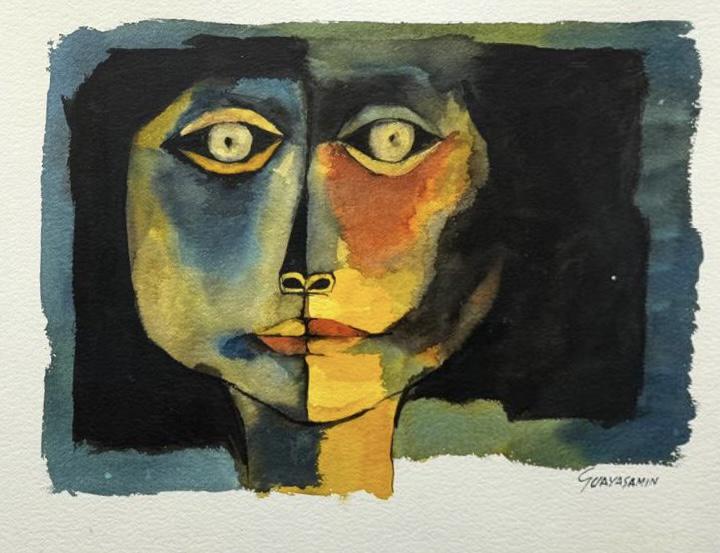
Cara (1942–1943) dates from the formative years of Oswaldo Guayasamín’s career, the period immediately following his graduation from the Escuela de Bellas Artes in Quito and preceding the long journey through Latin America that would give rise to Huacayñán. Executed in watercolour on paper, the work shows the young artist already committed to the subject that would define his entire output: the human face as a vessel for collective experience.
The composition is frontal and unwavering. A single head fills the sheet, set against a field of flat dark tone, with the features rendered in planes of ochre, blue and earth red. The face is divided vertically, one half cast in shadow, the other in light — a device Guayasamín would return to throughout his life.
The Divided Face
The bisected countenance is not a formal exercise. In Guayasamín’s language it carries the weight of a people split between inherited identity and imposed condition, a theme he encountered directly in the indigenous and mestizo communities of the Andes.
The eyes are the compositional centre: wide, fixed, ringed in dark pigment, they meet the viewer without appeal or accusation. This treatment — the enlarged, unblinking gaze — became one of the most recognisable elements of his visual vocabulary, and it is already fully formed here.
Early Watercolours
Guayasamín’s works on paper from the early 1940s reveal the influence of Mexican muralism, which he absorbed during his contact with Orozco, alongside the structural lessons of European modernism. The handling is direct and economical: broad washes laid down with confidence, the white of the paper left to breathe at the margins.
Watercolour suited the urgency of his early practice. It records decisions that cannot be undone, and in a work such as this the immediacy of the medium reinforces the frontality of the image.
Provenance & Documentation
Signed lower right.
Provenance: Private Collection Certificate: Fundación Guayasamín Reference: MC-GRO-04