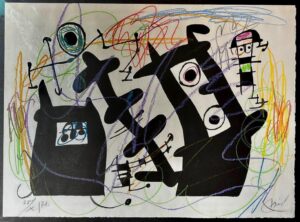
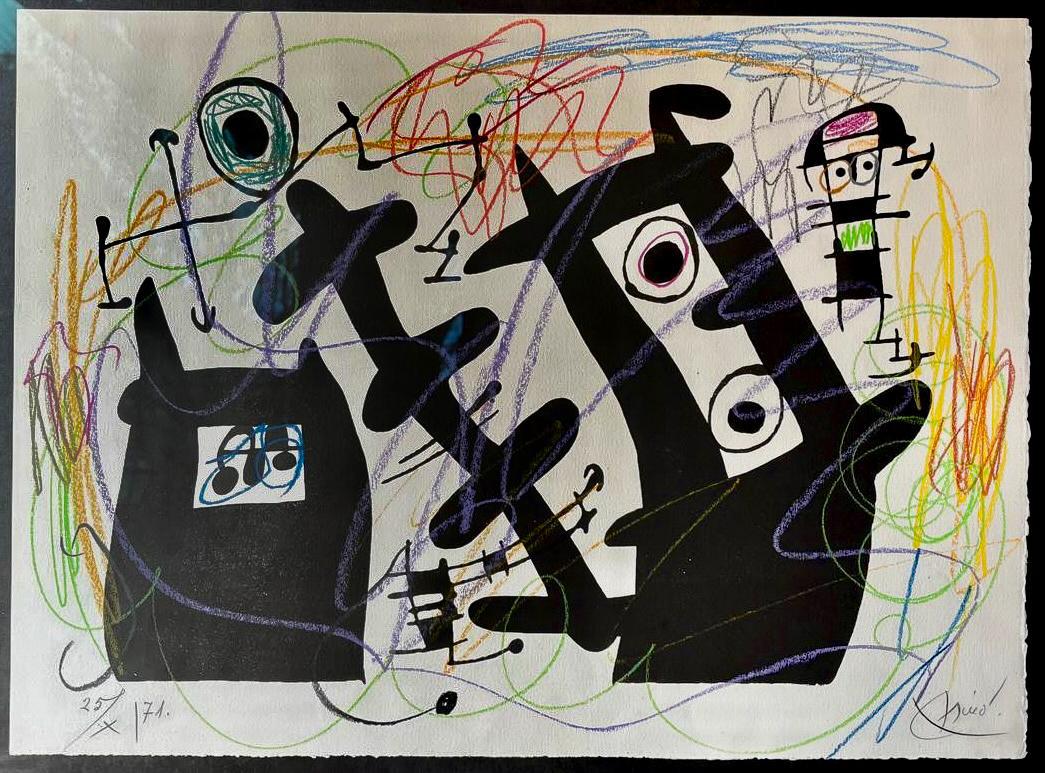
Executed in 1971, this work belongs to Miró’s practice of intervening by hand on printed sheets, transforming an existing image into a unique piece. Over a dense black composition — heavy interlocking forms, punctuated by staring eyes and a small chequered panel — the artist has laid a loose web of coloured pencil and wax crayon in green, yellow, red, blue and violet.
The two layers operate in open contradiction. Beneath, the printed forms are weighted, deliberate, architectural. Above, the crayon runs in fast loops and scribbles that respect none of the underlying boundaries.
Drawing over Print
This kind of intervention occupied Miró throughout the late period. He worked over proofs, trial sheets and rejected impressions, treating them not as finished objects but as grounds for a second act.
The gesture is deliberately undisciplined. The crayon marks look improvised, even careless, and that is their point: Miró sought a directness he associated with children’s drawing and with graffiti, and he pursued it most freely in works on paper.
Figures and Eyes
The black masses resolve, on looking, into personages. Eyes appear throughout — ringed, staring, placed without regard for anatomy. A small figure at the upper right carries a striped head and an open mouth.
These are the signs Miró had been refining since the 1920s, by this point reduced to their most emphatic form. What the coloured overdrawing adds is not clarification but energy: a field of movement surrounding forms that would otherwise sit still.
Provenance & Documentation
Signed lower right and numbered 25/X lower left, with the date 1971.
Provenance: Private Collection, Spain Certificate: ADOM (Association pour la Défense de l’Œuvre de Joan Miró) Reference: JM-GRO-02